
The AI Your Budget Isn't Buying
The CEO asked for something reasonable: every department should bring AI proposals for next year's budget. Fourteen came in. A customer-response drafting assistant, a copilot for the legal team, a product-description generator, an FAQ bot for the intranet, a meeting-minutes summarizer. Thirteen of the fourteen were variations on the same idea.
The fourteenth had come from the head of operations planning, and it never made it into the final deck. It was a stockout-prediction model his team had been asking for over two years, complete with a rough estimate of how much lost sales it could recover. Someone pulled it from the presentation before the meeting, with an argument that sounded reasonable enough at the time: that's not really AI, that's just statistics.
Of the fourteen, it was the only proposal that touched the margin directly.
That meeting wasn't an accident, and it wasn't one team's mistake. It was the predictable outcome of a mental filter running in nearly every executive committee today, one nobody ever says out loud: if it doesn't generate text, it doesn't count as AI.
The Filter Nobody Admits To
Gartner recently published a piece that gets at exactly this, built around a deliberately simple image: an atom where generative AI is just one of the electrons orbiting the nucleus, alongside optimization, simulation, rules and heuristics, non-generative machine learning, and graph analysis.
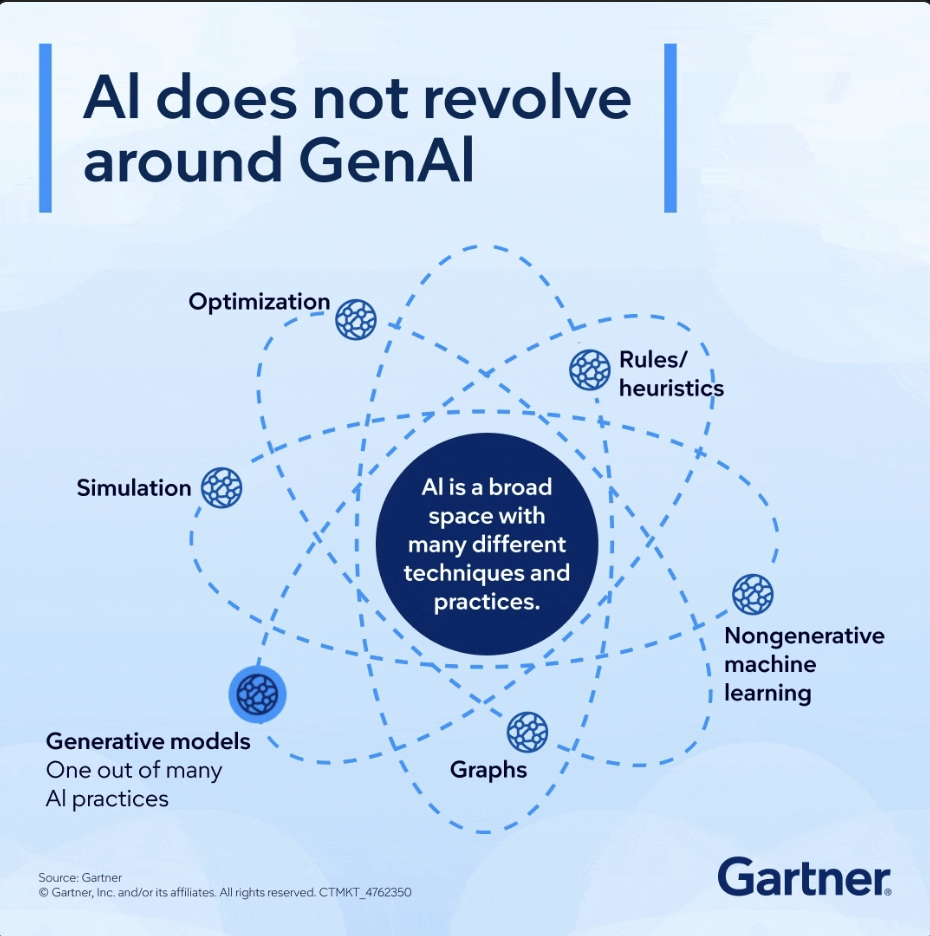
The title is a direct warning: "AI does not revolve around generative AI."
The problem is that trendy vocabulary has become a selection criterion. When a board asks "does this use generative AI?" instead of "does this solve the problem we actually have?", the buying process starts selecting for marketing instead of fit. And the tools that get filtered out are, more often than not, the very ones that have spent the last forty years solving the most expensive problems in the operation.
Two Doors In
There's a simple way to sort this out, one that works for a board-level conversation without getting into the technical weeds. AI enters a company through two different doors:
- Everyday experience and operations
- Decision-making and planning
The first door is for everything that touches people's day-to-day work and experience: wherever there's language, documents, conversations, and drafts. That's where generative models shine, and rightly so. An assistant that drafts the reply to a customer, a system that pulls the relevant clauses out of three hundred contracts, a copilot that cuts a sales team's proposal-prep time in half. This is the visible door, the one every company has already walked through, and the one that produces the demos that wow a room.
The second door is for everything that touches decisions and planning: wherever there are numbers, constraints, uncertainty, and real money on the line. It's a less photogenic door, and a considerably more profitable one. That's where prediction lives, answering what's going to happen:
- Which customers are likely to churn next quarter.
- How much demand each product will see at each location.
- Which transaction fits a fraud profile.
That's where optimization lives, answering what the best possible allocation is when there are more options than any human could evaluate: how to split six hundred deliveries across forty trucks with committed time windows, how to build a hospital's staff schedule while respecting both regulations and personal preferences.
That's where simulation lives, answering what if: ten thousand possible exchange-rate paths and their effect on cash flow over the next twenty-four months, run before committing the investment.
That's where rules and heuristics live too — the explicit knowledge of experts, coded into an engine that decides consistently and, unlike a statistical model, can explain exactly why it decided what it decided. And that's where graphs live, representing entities and relationships instead of rows and columns, and making it possible to spot the ring of coordinated accounts that no single transaction gives away on its own.
None of those five generate text. All five are AI. And at most companies, all five sit behind the door the committee isn't looking at.
The Question That Sorts Out the Portfolio
The practical consequence is straightforward, and you can check it in an afternoon. Take this year's list of approved AI initiatives and ask it one question: how many came in through each door?
If they all came in through the same one, the portfolio wasn't built around the business's actual problems. It was built around whatever vocabulary happened to be available.
There's a second check, an even more uncomfortable one: read how the objectives are actually worded. "Cut stockouts by thirty percent" has an owner, a line item on the P&L, and a clear condition for failure. "Implement AI in the supply chain" has none of the three — which is exactly why it's so easy to approve. A goal you can't fail isn't a goal.
What We're Seeing in Practice
At Itera, we've been working with organizations that arrive with an AI mandate already set and a portfolio built almost entirely through the first door. The most valuable work rarely means adding more initiatives — it means going back to the problems that were already on the table (inventory stockouts, resource allocation, customer churn, fraud) and asking which of the available tools actually fits each one. Sometimes the answer is a generative model. More often, it isn't, and that conversation ends up saving a lot more than it costs.
If you look at this year's budget and recognize the pattern of the fourteen proposals, let's talk. It's a half-day review, and it tends to reshuffle the priority list more than you'd expect.