
Are We Listening to the Piano Fall?
It's 1936. One in four American workers is unemployed. The Great Depression is in its seventh year.
Charles Chaplin released Modern Times that year, his first openly political film and the last appearance of his beloved Tramp.
The Tramp works the assembly line at Electro Steel Corporation, tightening bolts at a pace management controls from a screen. When he steps away from the machine, his body keeps moving with it, on its own, beyond his control. The production line eventually swallows him whole — the shot of the worker sliding through the gears is one of the most reproduced images of the last century.
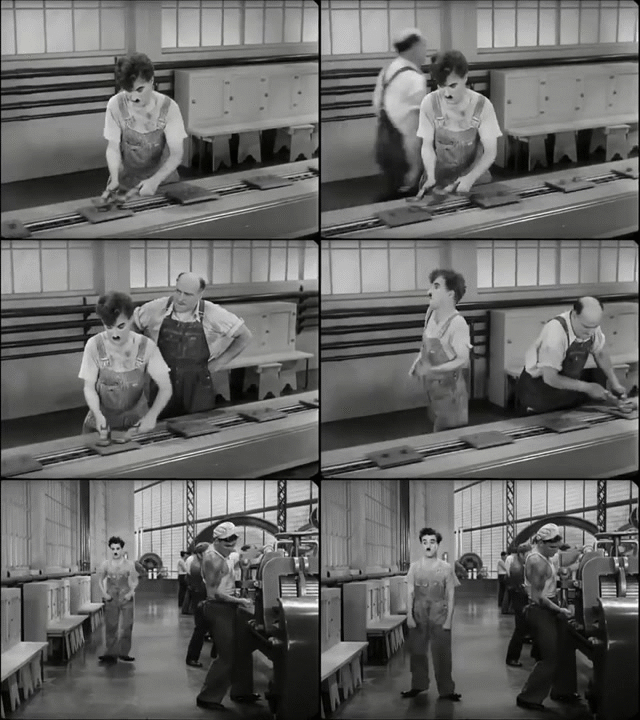
The Tramp collapses. Hospital. Diagnosis: nervous breakdown.
There was no villain on screen. Just the production line accelerating. Chaplin had been preparing the film for years. In a 1931 press interview, he'd said something that reads today like this morning's headline: something is deeply wrong when there are five million men out of work in the richest country in the world.
Ninety years later, the belt is still running. It changed material. Now it's digital, invisible, and we operate it ourselves, on ourselves.
Rockefeller Visits Quito, 1943
The young man was twenty-four, the eldest of ten children in a poor family from Quito, the son of a Quichua indigenous man who worked as a carpenter, a taxi driver, a truck driver. He'd finished art school two years earlier. In 1942 he held his first solo exhibition in a private Quito gallery and caused a scandal — critics said the work contradicted the school's principles. Among those who witnessed the scandal was Nelson Rockefeller, then head of the State Department's Office of Inter-American Affairs. He bought five paintings. He invited the young man to the United States.
Seven months touring museums. Goya, El Greco, Picasso, Velázquez. Then Mexico, working as Orozco's assistant. Then two years crossing Latin America — from Mexico to Patagonia, taking notes on Indigenous peoples, on Black communities, on mestizo communities. Out of those journeys came Huacayñán, a Quichua word: the road of tears. A hundred and three paintings.
And then, in the sixties, began the work that defines him. The Age of Wrath, painted between 1961 and 1990: more than two hundred fifty paintings and five thousand drawings. Within that series is The Scream — distorted faces and bodies, gestures of suffering, figures that seem to try to scream while the sound dies before it leaves the throat.
Oswaldo Guayasamín put it in his own words: the defining feature of this century is man's violence against man. And also: my painting is meant to wound, to scratch and strike at people's hearts. To show what man does against man.
He himself told the story, already old, in front of a camera filming him painting Paco de Lucía's portrait in 1994, recalling a scene from those early years. A New York critic in 1943, encountering his work for the first time, described it with an image Guayasamín repeated for the rest of his life:
it's like watching a grand piano fall from the top of a skyscraper. That loud, that brutal.
That's the image we have to hold onto. Because Chaplin showed the belt. Guayasamín named what the belt does.
The Book That Brings Us to 2026
In 2010, a South Korean philosopher teaching in Berlin published a hundred-and-twenty-page essay. Die Müdigkeitsgesellschaft in the original German, The Burnout Society in English translation. It was translated into more than thirty languages. Byung-Chul Han describes what Chaplin filmed and Guayasamín painted, but with the precise diagnosis of the twenty-first century.
The disciplinary society gave way to the achievement society. The external master who used to forbid was replaced by an internal one who demands. The old regime's "you must not" became the new regime's "you can." It sounds like freedom. It's the most efficient form of exploitation capitalism has ever invented, because the exploiter and the exploited are the same person. The achievement-subject exploits themselves, and does it voluntarily, convinced they're free.
Multitasking, Han writes bluntly, isn't a civilizational advance. It's regression. Attending to many things at once is what wild animals do to survive — watching for predators while eating, while mating, while tending their young. It's not an advanced capacity. It's a survival state. The vita contemplativa — the condition for all deep thought, all strategy, all creation — requires exactly the opposite: sustained attention on a single thing.
The founding myth Han uses is Prometheus. The eagle that eats his liver every day is himself. The pain, which in itself would be painless, is infinite exhaustion. There's no external punishment. There's no outside.
And the image that closes the diagnosis: the achievement-subject carries their own concentration camp with them. They're master and slave in the same body. No guards needed. They watch themselves.
What Guayasamín painted from the outside, looking at bodies marked by twentieth-century violence, Han describes from the inside. The same violence, now without visible bruises. It's the violence of man not against man, but against himself.
The Belt Returns, Now Accelerated by AI
Let's go back to Chaplin for a moment. Management raised the line's pace from a screen. The Tramp couldn't negotiate the speed: he could only try to keep up until his body failed.
In AI-enabled environments, the human has a technical name: human-in-the-loop. The link responsible for judgment, discernment, ethical reasoning, strategic vision. It's the one component of the system AI still hasn't replaced — and that's exactly why it's the point where the system is going to stall. Goldratt's theory of constraints is unforgiving: every system moves at the pace of its bottleneck. Not the fastest component's pace. The slowest one's.
AI does most of the loop at machine speed. It researches, drafts, analyzes, synthesizes, produces drafts, consolidates data. And it hands the human something they've never received before: tons of ready-to-review work. Proposals ready-to-approve. Decisions ready-to-sign. Code ready-to-merge. Emails ready-to-send. The belt no longer carries bolts. It carries pending judgment calls.
And right there, precisely there, arrives the Thursday executive. The one who was already reporting exhaustion before AI existed. The one who already lived in survival mode, with no vita contemplativa, no room to think about one thing at a time. That exhausted human is now the only component of the system that can discern whether the AI's proposal makes strategic sense, whether the code introduces an invisible risk, whether the email is about to destroy a ten-year relationship.
AI didn't free them. It left them alone, at the end of a belt that accelerates without pause, carrying the entire weight of judgment in a body that can no longer contemplate.
The success factors of the AI era aren't primarily technical. They're human. Judgment, discernment, the ability to decide what to automate and what not to, the ability to detect when the machine is confidently wrong. And those are exactly the capacities the achievement society atrophies.
The Tramp ran with his wrenches until the belt swallowed him. Today the belt isn't even necessary. The executive runs alone.
The Impossible Bootstrap
Every Thursday afternoon, at the start of a session in the Enabling Leadership coaching program we're running with a client's team leaders, we ask how they're doing.
They're competent, responsible, committed professionals. They're the critical link the theory of constraints points to. And they arrive on Thursday in the exact state Han described, that Guayasamín painted, that Chaplin filmed. No visible bruises. With the scream embodied but silent, turned inward.
The answer, week after week, without variation: we're exhausted. Not as a complaint. As a report. As if exhausted were the operating system's default state.
Let's pause on what's being asked of these leaders. They're asked to think strategically. Thinking strategically requires time — protected time, uninterrupted time, time where vita contemplativa is possible. Having that time requires delegating. Delegating isn't pushing tasks downward: it's training someone to solve with judgment, sustaining the process while they learn, correcting, trusting, letting go. Delegating well takes months. And delegating well requires — exactly — protected time to think strategically about what to delegate, to whom, and how.
The circle closes in on itself with no door in from the inside. Asking someone to be more strategic without creating that initial space is asking them to lift themselves off the ground by their own bootstraps.
It's not a metaphor. It's a technical description. The person who's exhausted can't build the space they need to stop being exhausted, because building that space requires the very capacity exhaustion took from them. Every week that passes without outside intervention, the circle tightens a little more. Every urgent project with yesterday's deadline, every AI tool handed to them with no time to learn it, every meeting that couldn't be cancelled — all of it pushes in the same direction: more ready-to-solve tasks landing on someone who can no longer stop to think which of them is worth doing.
The Question We're Leaving Open
The mold isn't individual. It runs through the entire chain. The leaders reporting exhausted on Thursdays have bosses who are also exhausted, who report to bosses who are also exhausted. Nobody has the time, because nobody above gave themselves the time. There's no gardener because the system never cultivated the ones who were supposed to become one. Every level reproduces onto the next exactly what it received from the one above: urgency without pause, demand without space, performance without contemplation.
The urgency is real, and it's now. While the executive runs behind the belt AI is accelerating, the people working alongside them — the ones who could be developing judgment, discernment, strategic vision, the only capacities that will differentiate organizations over the next ten years — go home Friday with the same report as Monday. Another week without contemplating. Another piano falling with nobody listening.
At Itera we work with organizations caught in that tension: they need more strategic, enabling leaders, and at the same time they have them buried in operations, with no time to contemplate whether what they're doing matters.
The pianos are starting to fall. The ones already in the air, you're not going to stop. The question is whether you're going to close the window before they push the next one.
No piano stops on its own. Who, in your organization, is going to close the window?